Advanced Laparoscopic Hernia Surgery in Delhi
Precision 4K Keyhole & Tension-Free 3D Mesh Repair by Senior Surgeon Dr Amita Jain
Quick Summary for Patients:
What Is a Hernia?
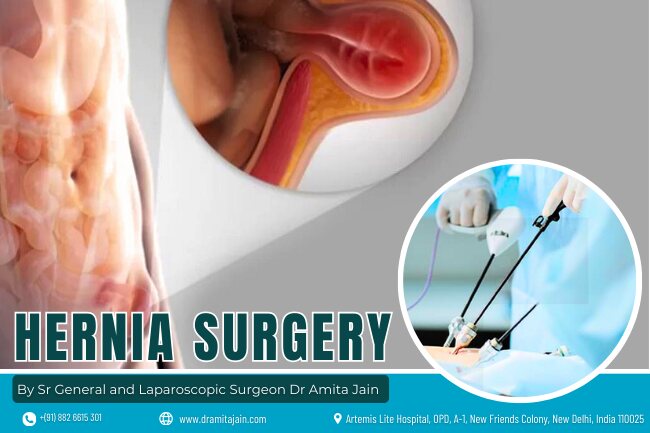
A hernia occurs when an internal organ, segment of tissue, or fatty cushion pushes through an abnormal opening, tear, or weakness in the surrounding muscle or connective tissue (fascia) that normally contains it.
While hernias most frequently develop in the groin and abdominal wall (such as inguinal, femoral, umbilical, and incisional hernias), they can also occur internally—such as a hiatal hernia, where the upper part of the stomach pushes upward through the diaphragm into the chest cavity.
In external hernias, the condition typically manifests as a visible bulge, palpable lump, or localized swelling that becomes more prominent during physical activities that increase internal pressure—such as standing, lifting heavy objects, coughing, bending over, or straining.

Why Medication, Belts, or Trusses Cannot Cure a Hernia?
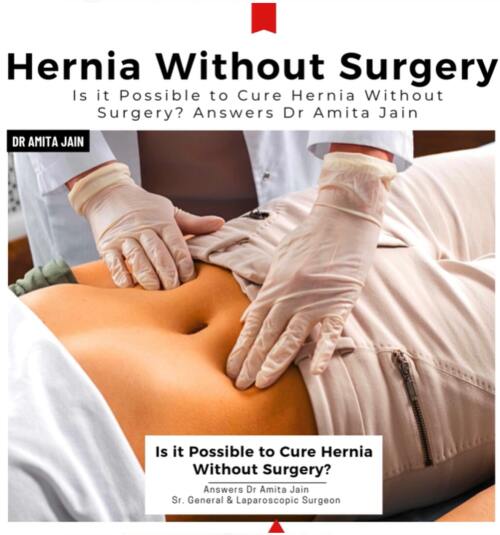
An established adult hernia is a purely mechanical and structural defect, not an illness that can heal on its own.
- Medications Cannot Close a Physical Defect: Ointments, painkillers, antacids, or stool softeners can temporarily ease secondary symptoms (such as pain, acidity, or straining), but they cannot regenerate, bridge, or stitch together torn muscular and fascial boundaries.
- Belts and Trusses Offer Only Temporary Support: External supportive garments (such as trusses, binders, or belts) merely provide superficial counter-pressure to keep external tissues from slipping out. They do not reconstruct the underlying anatomical defect. Over time, chronic reliance on tight trusses can weaken surrounding muscle tone and cause skin friction, irritation, and tissue scarring.
- Definitive Surgical Repair Is the Only Cure: Structural defects require structural solutions. Modern surgical repair—performed through advanced minimally invasive (laparoscopic/keyhole) or open techniques—is the only definitive treatment. Surgery safely returns the herniated tissue to its proper anatomical compartment and permanently reinforces the weakened boundary, typically with a biocompatible, tension-free surgical mesh.
Types of Hernias Treated with Laparoscopic Precision
Dr Amita Jain provides anatomical, grade-specific hernia repair customized to the defect’s location, diameter, and patient lifestyle:
| Hernia Type |
Anatomical Defect Location & Symptoms |
Gold Standard Surgical Treatment |
| Inguinal Hernia (Groin) |
The most common hernia (up to 75% of cases). Presents as a bulge in the groin or scrotum that worsens with coughing or standing. |
Laparoscopic TEP or TAPP Repair with high-grade anatomical 3D contoured mesh placement. |
| Umbilical Hernia (Navel) |
A defect at the umbilical ring, causing an outward protrusion of the belly button, frequently seen post-pregnancy or with weight gain. |
Laparoscopic IPOM (Intraperitoneal Onlay Mesh) or open Mayo repair with anatomical fascial closure. |
| Incisional Hernia (Post-Surgical) |
Arises along the scar line of a previous abdominal operation (e.g., C-section, hysterectomy, or bowel surgery) due to impaired tissue healing. |
Advanced Laparoscopic Abdominal Wall Reconstruction (e-TEP / IPOM Plus) with composite anti-adhesive barrier mesh. |
| Femoral Hernia (Upper Thigh) |
Occurs just below the groin crease near the femoral vessels; far more common in women and carries a high risk of acute strangulation. |
Emergency or Elective Laparoscopic Groin Hernioplasty to relieve the tight femoral ring and reinforce the floor. |
| Epigastric / Ventral Hernia |
Defects situated along the midline (linea alba) between the navel and breastbone, presenting with localized tenderness and a palpable lump. |
Minimally Invasive Sublay / IPOM Laparoscopic Repair preserving the natural contours of the abdominal wall. |
Common Causes of Hernia Development
Hernias develop when persistent internal abdominal pressure overcomes a weakened muscular wall:
- Pregnancy & Multiple Childbirths: Severe stretching of the abdominal musculature, often resulting in rectus diastasis and umbilical herniation.
- Chronic Constipation & Urinary Strain: Habitual straining caused by hard bowel movements or benign prostatic hyperplasia (BPH).
- Persistent Coughing & Sneezing: Chronic bronchitis, smoking-induced smoker’s cough, or allergic asthma causing repeated high-pressure spikes.
- Heavy Weightlifting & Occupational Straining: Sudden, repetitive intra-abdominal strain without adequate core stability.
- Previous Surgical Incisions: Incomplete deep fascial healing or post-operative surgical site infection weakening a previous scar.
- Central Obesity: Visceral fat placing continuous outward mechanical pressure against the anterior abdominal wall.
Warning Signs & Symptoms: When Is a Hernia Dangerous?
Early Common Symptoms:
- A visible bulge in the groin, navel, or surgical scar that may disappear when lying flat (reducible hernia).
- A dragging, heavy sensation, or dull ache in the lower pelvis or groin after standing or walking for extended periods.
- Sharp localized pain triggered by coughing, bending, lifting weights, or straining at stool.
Red Flag Symptoms: Incarceration & Strangulation Emergency
If protruding intestinal loops become trapped inside the defect, the hernia becomes incarcerated. If the blood supply is cut off, it leads to gangrene and strangulation—a critical surgical emergency.
Seek Immediate Emergency Medical Care If You Develop:
- Sudden, severe, escalating abdominal or groin pain.
- A hernia bulge that suddenly becomes hard, intensely tender, and cannot be pushed back inside.
- The skin over the hernia turns red, dark purple, or bruised.
- Persistent nausea, projectile vomiting, and abdominal bloating.
- Inability to pass flatus (gas) or have a bowel movement (complete intestinal obstruction).
Comprehensive Hernia Diagnosis in South Delhi
Accurate diagnostic staging prevents unexpected operative complications:
- Dynamic Physical Examination: Evaluation in both standing (erect) and lying (supine) postures while performing a controlled cough impulse (Valsalva maneuver).
- High-Definition Abdominal & Groin Ultrasound (USG): Quantifies the exact neck diameter of the fascial defect and confirms whether it contains omental fat or viable bowel loops.
- Contrast-Enhanced Dynamic CT (CECT) Abdomen: Performed for recurrent hernias, large multi-defect incisional hernias, or suspected loss of abdominal domain to create a precise 3D preoperative surgical reconstruction plan.
Advanced Surgical Techniques: 4K Laparoscopic vs. Open Repair
1. Advanced 4K Laparoscopic Hernia Repair (TEP / TAPP / IPOM)
Minimally invasive keyhole surgery is the gold standard worldwide for uncomplicated inguinal, umbilical, and ventral hernias:
TEP (Totally Extraperitoneal): The entire repair is performed inside the abdominal wall layers without even entering the peritoneal cavity containing the intestines, virtually eliminating the risk of visceral injury.
TAPP (Transabdominal Preperitoneal): The surgeon works from inside the abdomen, peels back the peritoneal flap, positions an anatomical mesh over all groin potential weak points (direct, indirect, and femoral spaces), and closes the flap securely over the mesh.
Key Benefits:
- Only 3 micro-incisions (5 mm to 10 mm), eliminating large, painful scars.
- Significantly lower wound infection rates compared to open surgeries.
- Faster mobilization: walking within 4–6 hours, discharge within 24 hours.
- Ideal for bilateral (both sides) groin hernias—both repaired through the same three keyhole ports without extra incisions.
2. Modern Tension-Free Open Hernioplasty (Lichtenstein Technique)
While laparoscopy is prioritized, open hernia repair remains indispensable for:
- Extremely large, complex scrotal hernias or giant incisional hernias with extensive adhesions.
- Patients with severe cardiopulmonary conditions who cannot undergo general anesthesia with carbon dioxide (pneumoperitoneum).
- Open repairs can be safely conducted under regional (spinal) or targeted local anesthesia.
| Clinical Feature |
4K Laparoscopic Hernia Repair |
Conventional Open Hernioplasty |
| Incision Size |
3 tiny keyhole punctures (5–10 mm) |
6 to 10 cm single linear incision |
| Tissue Dissection |
Minimal trauma; precise microscopic view |
Extensive muscle and soft-tissue cutting |
| Postoperative Pain |
Minimal to mild; easily managed with oral painkillers |
Moderate to severe; requires stronger analgesia |
| Bilateral Hernia Repair |
Both sides repaired through the same 3 keyholes |
Requires 2 separate large incisions in both groins |
| Hospital Stay |
Daycare or 24-Hour Discharge |
2 to 4 Days depending on healing |
| Return to Desk Work |
3 to 5 Days |
2 to 3 Weeks |
| Full Heavy Gym / Lifting |
3 to 4 Weeks |
6 to 8 Weeks |
| Recurrence Rate |
< 1% in expert surgical hands |
< 2% with tension-free mesh |
Enhanced Recovery Protocol: What to Expect After Surgery
- Day of Surgery (Hours 0–6): Anesthesia recovery in our high-dependency unit. Oral liquid intake and assisted walking are initiated within a few hours.
- Discharge (24 Hours): Most patients meet all discharge criteria, tolerate a light normal diet, pass urine easily, and are discharged home comfortably.
- Days 3 to 5 (Back to Routine): Dressings remain clean and dry. Most patients comfortably resume office work, computer work, driving automatic vehicles, and gentle household activities.
- Weeks 2 to 3 (Active Living): Brisk walking, light cycling, and routine stair climbing are fully encouraged.
- Weeks 4 to 6 (Peak Core Strength): Complete mesh incorporation and tissue collagen cross-linking. Return to gym workouts, jogging, weightlifting, and sports is authorized following your review with Dr Amita Jain.
Why Delhi NCR Trusts Dr Amita Jain for Hernia Surgery
- 29+ Years of Surgical Mastery: Former Indian Army Trauma Surgeon (Operation Vijay / Kargil War veteran) and Post-Doctoral Fellow from AIIMS, New Delhi, offering military-grade protocol discipline and surgical precision.
- Advanced 4K Optical Towers & 3D Ergonomic Mesh: Utilizing globally certified, biocompatible polypropylene and dual-surface barrier composite meshes that prevent adhesions and eliminate nerve entrapment pain.
- Aesthetic & Muscle-Preserving Focus: Meticulous port placement in natural pelvic skin creases ensures near-invisible scar marks and maintains natural abdominal wall aesthetics.
- Female Hernia Specialist: Discreet, highly empathetic clinical environment for female patients suffering from post-pregnancy umbilical hernias or femoral defects.
- 100% Cashless Insurance Coordination: Hassle-free pre-authorization with Star Health, HDFC Ergo, Care, ICICI Lombard, Max Bupa/Niva Bupa, Medi Assist, Paramount, and CGHS/ECHS panels.
"Visceral pain from a hernia presents as a localized burning, dull ache, or pelvic pressure. When no visible protrusion is present, these structural issues are often missed, mistaken for muscle strains, renal, or gynecological issues before diagnosis."
— Dr Amita Jain, Sr General, Proctologist & Laparoscopic Surgeon at Fortis C-DOC Hospital, Rosewalk Hospital, Rainbow Children’s Hospital and Daffodil Artemis Hospital.
Expert Hernia Care in South Delhi. Consult Dr Amita Jain Today.
Dr. Amita Jain offers patients the flexibility of specialized surgical care at several premium healthcare facilities across South Delhi. Depending on their specific needs and convenience, patients can choose to be operated on at prestigious locations, including:
- Fortis C-Doc Hospital : OPD, B-16, Nehru Place Flyover, opp. Devika Tower, Chirag Enclave, Greater Kailash, New Delhi, Delhi 110048
- Rosewalk Luxury Maternity Hospital : OPD, N-88, Block N, Panchsheel Park North, Panchsheel Park, New Delhi, Delhi 110017.
- Madhukar Rainbow Children's Hospital : OPD, FC-29 5, Geetanjali Marg, near Malviya Nagar, Block A, Shivalik Colony, Malviya Nagar, New Delhi, Delhi 110017
- Daffodils By Artemis Hospitals: F-44, Block F, East of Kailash, New Delhi, Delhi 110065
Book Your Appointment
Note : Medically Reviewed by Dr. Amita Jain | Senior Surgeon & HOD | Updated September 2026
Patient Testimonials
★★★★★
"I recently underwent a laparoscopic surgery for gallstones with Dr. Amita Jain, and I had an excellent experience. From the very beginning, she made me feel extremely comfortable and confident about the procedure. Her calm and reassuring manner gave a personal touch that really put me at ease. She took the time to explain everything clearly and answered all my questions patiently. The surgery went smoothly, and the recovery was much easier than I expected, thanks to her care and guidance.
I’m truly grateful to Dr. Amita for her professionalism, compassion, and personal attention. I would highly recommend her to anyone in need of a skilled and caring surgeon."
★★★★★
"Dr Amita Jain has been a great blessing to us. She performed my mother's gall bladder surgery, which went remarkably smoothly and without any issues. Initially, she thoroughly explained every detail of the procedure to us, ensuring we fully understood it. After the surgery, my mother was moved to the ward within just 30-40 minutes. Dr. Jain's approach to both pre-operative and post-operative care was outstanding and significantly contributed to my mother's swift recovery. Not only was Dr. Jain highly professional, but she also provided us with warmth and reassurance, making us feel confident about the success of the surgery."
★★★★★
I had 21 mm (2.1 cm) Gallbladder stone. My consulting doctor and surgeon was Col.Doctor Amita Jain. It gives me immense pleasure to share that she not only apprised me about Gallstones reactions on body in a very detailed and simple manner but also helped me to arrive at a decision logically to remove the diseased organ from the body at the earliest. As for most of us, any surgical decisions are tough to take, but Doctor Col. Amita Jain explained me very well and made it very easy for me to finalize. All throughout my journey of treatment she was very cordial, supportive, friendly and most jovial. She gave me immense courage at every step fortifying my mental and physical health. ...
★★★★★
"Thank you mam for kind gesture and complete information helping me to take right decision about my umbilical hernia. Really appreciate your help helping me physically and financially. I am happily on my course to recovery now."
★★★★★
"We recently consulted Dr. Amita Jain for a family member’s Pilonidal sinus surgery. She is extremely knowledgeable, confident, soft-spoken, and compassionate. The surgery went smoothly, and she made sure we were comfortable throughout. Dr. Amita was always responsive on WhatsApp/phone and even called us to check on the patient. Highly recommend her for her expertise and caring nature."
★★★★★
"On the 28th of March, I got my External haemorrhoids treated by Amita mam. Being a defence aspirant and considering the limited time frame I had available, mam took me in confidence and treated me with dexterity. She took very fine care of me and answered every query with patience and expertise. I finally got medically fit within the required time frame. Grateful to Dr Amita mam, Thanks again 🙏🏻"
Frequently Asked Questions
What are the key signs that help a patient identify a hernia?
A hernia typically appears as a visible, soft lump or swelling under the skin in the abdomen or groin area. This lump often becomes more prominent when standing up, coughing, straining, or lifting heavy objects, and it may disappear or flatten out completely when lying down. Patients usually experience a dull ache, heavy sensation, or burning feeling around the swelling rather than a sharp, cutting pain.
Can a hernia heal on its own with exercise or medical support?
No, a hernia is a physical, structural defect in the muscle wall and cannot heal on its own or be cured with medication. Over time, the continuous pressure from daily activities causes the muscle tear to stretch and enlarge. While supportive belts or lifestyle adjustments can provide temporary comfort, structural surgical repair is the only definitive way to close the muscle gap and prevent serious issues.
When does a simple abdominal or groin hernia turn into a dangerous medical emergency?
A hernia becomes an emergency if it becomes incarcerated or strangulated, which means the protruding tissue gets tightly trapped outside the muscle wall and its blood supply is cut off. Immediate emergency attention is required if the lump becomes extremely painful, hard, or discolored, or if the patient experiences severe nausea, vomiting, an inability to pass gas, or a high fever.
What advanced minimally invasive techniques are used to repair modern hernias?
Modern abdominal wall repairs utilize advanced, muscle-reinforcing keyhole techniques such as Laparoscopic Transabdominal Preperitoneal repair and Totally Extraperitoneal repair. These precise methods involve placing a customized, biocompatible medical mesh over the weak spot through tiny incisions, structurally reinforcing the muscle wall from behind without creating large open wounds.
How long does it take to fully recover after laparoscopic hernia surgery?
Laparoscopic hernia repair is standardly performed as a quick daycare procedure, allowing patients to comfortably return home within 24 hours of the operation. Most individuals can resume light daily walks and sedentary desk work within 3 to 5 days. However, heavy lifting, pushing, and intense physical workouts must be strictly avoided for 4 to 6 weeks to let the mesh secure itself completely.
What is the purpose of using a surgical mesh during a hernia repair?
The medical mesh acts as a durable, flexible scaffold that supports the weakened tissue layers while the body builds its own strong scar tissue over it. Using a mesh significantly reduces the tension on the surrounding muscles, which lowers post-operative discomfort and reduces the risk of the hernia returning from over 10% in traditional repairs to less than 1% in modern procedures.
Can chronic coughing, lifting heavy objects, or constipation cause a hernia to develop?
Yes, anything that creates sudden or continuous high pressure inside the abdomen can force tissues through a natural weak spot in the muscle wall. Frequent causes include improper heavy lifting techniques, a persistent chronic cough from smoking or respiratory issues, severe straining due to long-term constipation, and natural muscle weakening from aging or previous abdominal surgeries.
Are there any permanent dietary or physical limitations after recovering from a hernia repair?
No, once the recovery phase is complete and the muscle wall has bonded securely with the mesh, patients do not face permanent lifestyle or physical restrictions. In fact, a successful repair allows individuals to return safely to an active life, including sports and heavy workouts, provided they maintain core strength and use proper lifting mechanics to avoid unnecessary abdominal strain.
Why do complex, large, or recurrent hernias require a highly experienced specialist?
Complex cases—such as hernias that have broken through a previous surgical site (incisional hernias), massive multi-defect defects, or hernias that have returned after prior operations—demand advanced reconstruction expertise. Dr Amita Jain utilizes her extensive surgical experience to carefully separate dense scar tissue, perform advanced abdominal wall component separation, and safely place specialized mesh to restore full structural integrity.
Where in Delhi can patients book a consultation with Dr Amita Jain for advanced hernia care?
Dr Amita Jain provides expert evaluations and performs advanced laparoscopic hernia repairs at leading medical institutions across New Delhi. Patients can book an appointment to see her at Fortis C-DOC (Chirag Enclave), Rosewalk Hospital (Panchsheel Park), and Madhukar Rainbow Children’s Hospital (Malviya Nagar).

 Read on Google