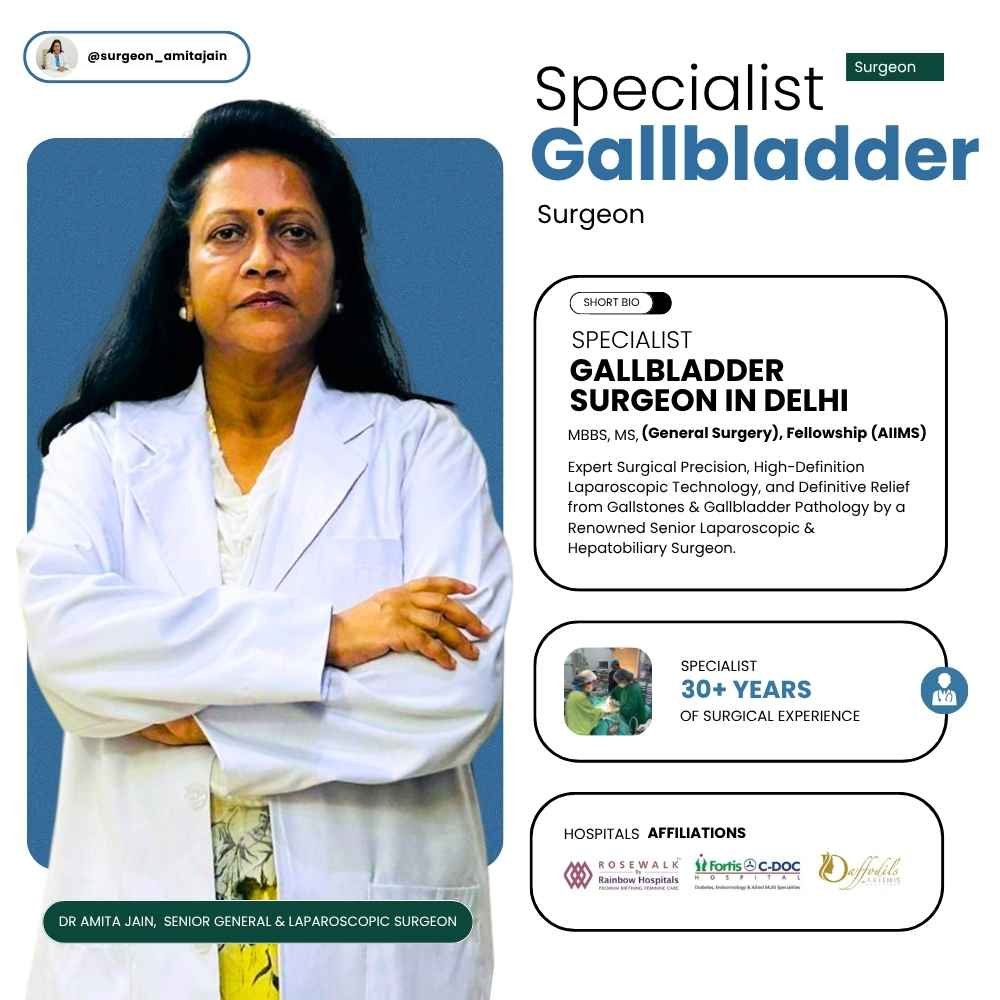
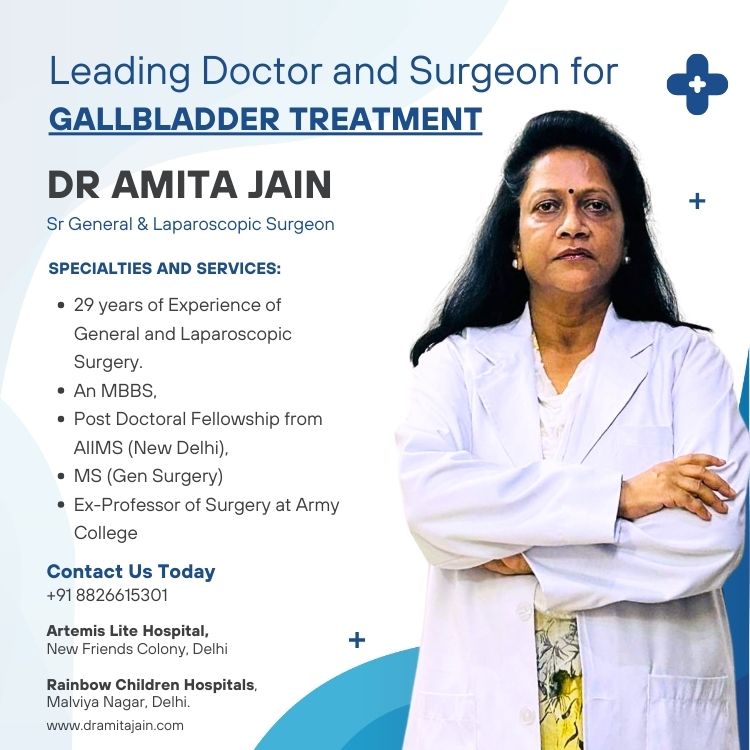
Surgeon: Dr Amita Jain
MBBS, MS (General Surgery, Gold Medalist), AIIMS Post-Doctoral Fellow, Ex-Indian Army Surgeon (29+ Years Surgical Experience).
Education & Credentials:
- MBBS: NSCB Govt. Medical College, Jabalpur (MP)
- MS (General Surgery – Gold Medalist): NSCB Govt. Medical College, Jabalpur (MP)
- Fellowship: Post-Doctoral Fellow, All India Institute of Medical Sciences (AIIMS, New Delhi)
- Medical Registration Number: 10883
Professional Memberships
- The Association of Surgeons of India (ASI) — Life Fellow Member No: FL 9945
- Association of Minimal Access Surgeons of India (AMASI) — Member No: 10314
Care Model
Minimally Invasive 3-to-4 Port Keyhole Technique, Strict "Critical View of Safety" (CVS) Protocol, Evidence-Based ERAS Pathway, Minimal Post-Operative Pain, and Accelerated 24–48 Hour Recovery.
Procedures Offered
Gallbladder Stone Removal Surgery, Gallbladder Removal Surgery (Laparoscopic Cholecystectomy), Gallbladder Bile Duct Injury Repair Surgery, Gallbladder Drainage Cholecystostomy, Gallbladder Polyp Surgery, Partial Cholecystectomy, and Treatment for Gallbladder Stones During Pregnancy.
Minimally Invasive Management of Gallbladder Pathology (Diseases of the Gallbladder)
Expert Surgical Precision, High-Definition Laparoscopic Technology, and Definitive Relief from Gallstones & Gallbladder Pathology by a Renowned Senior Laparoscopic & Hepatobiliary Surgeon.
With nearly three decades of dedicated surgical experience, Dr Amita Jain specializes in advanced laparoscopic techniques (minimally invasive keyhole surgeries) for hepatobiliary diseases (conditions affecting the liver, gallbladder, and bile ducts). Her clinical methodology, refined during her distinguished service in the Armed Forces Medical Services, prioritizes meticulous preoperative risk stratification (assessing patient health before surgery), strict adherence to surgical safety checklists, and definitive anatomical identification during minimally invasive procedures..
Laparoscopic gallbladder removal demands an absolute understanding of variable hepatobiliary anatomy, particularly the structural boundaries of Calot's triangle (the critical surgical zone containing the main gallbladder arteries and ducts). Dr Jain’s surgical practice emphasizes a disciplined, systematic approach to the isolation of the cystic duct (the tube draining the gallbladder) and the cystic artery. This rigorous technique ensures a definitive "critical view of safety" (a standardized medical safety baseline before cutting), substantially mitigating the risks of common bile duct anomalies or intraoperative vascular injury, thereby supporting accelerated recovery timelines and optimal patient outcomes.
Clinical Spectrum of Gallbladder Pathology & Stage-Specific Surgical Approaches
| Gallbladder Condition |
Clinical Presentation & Diagnostic Indicators |
Recommended Surgical & Clinical Treatment |
| Symptomatic Gallstones (Cholelithiasis / Biliary Colic) |
Episodic, intense right upper quadrant (RUQ) or epigastric pain radiating to the back/shoulder; often triggered by fatty meals and mistaken for hyperacidity. |
Elective Laparoscopic Cholecystectomy (Keyhole Surgery); complete gallbladder removal to eliminate stone recurrence and prevent future ductal obstruction. |
| Acute & Chronic Cholecystitis |
Constant, severe RUQ pain, tenderness (positive Murphy’s sign), localized peritoneal guarding, fever, nausea, and leukocytosis (elevated WBC count). |
Urgent Laparoscopic Cholecystectomy under early ERAS protocol; definitive dissection within Calot’s triangle before tissue necrosis or empyema develops. |
| Dense Adhesions / "Frozen" Calot’s Triangle |
Severe internal scarring, anatomical distortion, or gangrenous inflammation where isolating the cystic duct and artery poses high injury risk. |
Laparoscopic Subtotal (Partial) Cholecystectomy; safe excision of the anterior gallbladder wall and fundus while protecting the common bile duct and liver bed. |
| Gallbladder Polyps (>10 mm or High-Risk) |
Usually asymptomatic mucosal outgrowths identified on routine ultrasound; polyps exceeding 10 mm or showing serial vascularity carry high malignant risk. |
Prophylactic Laparoscopic Cholecystectomy; complete resection for oncological safety and histological evaluation before malignant transformation. |
| Bile Duct Injuries (BDI) & Biliary Strictures |
Post-operative bile leak, localized or generalized peritonitis, progressive obstructive jaundice (yellow skin/eyes), dark urine, and abdominal sepsis. |
Complex Biliary Reconstruction; specialized Roux-en-Y Hepaticojejunostomy to restore direct, unobstructed bile drainage into the small intestine. |
| Acalculous / Severe Cholecystitis (in Critically Ill) |
Severe sepsis, gallbladder empyema, or localized perforation in elderly/ICU patients temporarily unfit to tolerate general anesthesia. |
Image-Guided Cholecystostomy (Percutaneous Drainage); emergency bedside catheter decompression to clear pus and stabilize the patient for later surgery. |
| Gallstones During Pregnancy |
Recurrent biliary colic or acute cholecystitis exacerbated by high progesterone levels and biliary stasis, unresponsive to dietary therapy. |
Second-Trimester Laparoscopic Cholecystectomy; performed using careful open-entry access and low-pressure insufflation to ensure maternal and fetal safety. |
Clinical Insight from Dr Amita Jain:
"Symptomatic gallstone disease is frequently misdiagnosed during its initial presentation because early biliary colic (sudden, severe gallbladder pain) mimics benign gastric hyperacidity or non-specific dyspepsia (indigestion). However, persistent, localized pain in the right upper quadrant (upper right abdomen) or epigastrium—particularly when exacerbated by fatty meals and accompanied by nausea—demands formal diagnostic ultrasound evaluation. Early identification prevents emergency presentations of cholecystitis (gallbladder infection), choledocholithiasis (stones blocked in the main duct), or gallstone pancreatitis (dangerous swelling of the pancreas)."
— Dr Amita Jain, Sr General, Proctologist & Laparoscopic Surgeon at Fortis C-DOC Hospital, Rosewalk Hospital, Rainbow Children’s Hospital and Daffodil Artemis Hospital.
Dr Jain currently consults and performs surgeries at Fortis C-DOC Hospital, Rosewalk - Luxury Maternity Hospital Panchsheel Park, Delhi, and Rainbow Children’s Hospital in Malviya Nagar, Delhi. Her long surgical experience, combined with the discipline and precision developed during her years as an Army surgeon, has established her as a trusted name for advanced gallbladder surgery in Delhi NCR.
Patients seeking safe, minimally invasive gallbladder surgery in Delhi benefit from her structured surgical approach, personalized treatment planning, and commitment to delivering high-quality care with precision, safety, and long-term patient well-being at the forefront.

Clinical Indications for Surgical Intervention (When Surgery is Needed)
The gallbladder functions as a physiological reservoir for bile, a digestive fluid synthesized by the liver and transported via the biliary tree (bile duct network) into the duodenum (the first part of the small intestine) to emulsify dietary lipids (break down fats). Gallstones (cholelithiasis) develop when chemical imbalances cause bile constituents, such as cholesterol or bilirubin (bile pigment), to supersaturate and precipitate into solid crystalline structures.
Surgical intervention becomes mandatory when these calculi (stones) migrate and obstruct the cystic duct or common bile duct, disrupting normal biliary flow and elevating intraluminal pressure (pressure inside the organ). This obstruction can rapidly progress to severe complications, including gallbladder empyema (pus formation inside the gallbladder), localized perforation (rupture or bursting of the organ), or life-threatening systemic sepsis (severe whole-body blood infection).
Definitive laparoscopic evaluation determines whether acute symptoms stem from uncomplicated biliary colic (temporary stone blockage pain) or require urgent intervention for conditions such as acute cholecystitis (sudden, severe infection), choledocholithiasis (stones trapped in the main bile tube), or biliary tract trauma. Furthermore, Gallbladder Polyp Surgerysurgical management is indicated for gallbladder polyps with malignant (cancerous) potential, radical resections for early-stage gallbladder malignancies, subtotal cholecystectomy for dense anatomical scarring, and emergency drainage procedures to stabilize compromised patients.

Comparison of Gallbladder Surgical Modalities
| Feature |
Conservative / Medical Observation |
Laparoscopic Cholecystectomy (Gold Standard) |
Subtotal (Partial) Cholecystectomy |
Open Cholecystectomy / Surgical Repair |
| Best Suited For |
Asymptomatic stones or temporary pre-op stabilization |
Symptomatic gallstones, polyps, uncomplicated cholecystitis |
Severe acute scarring, gangrene, or obscured Calot’s triangle |
Massive trauma, conversion cases, or complex biliary reconstructions |
| Surgical Incisions / Access |
None |
3 to 4 tiny keyhole punctures (5 mm – 10 mm) |
3 to 4 keyhole ports (laparoscopic approach) |
10 cm – 15 cm subcostal (Kocher's) abdominal incision |
| Safety Protocol |
Symptomatic monitoring only (high complication risk) |
Strict confirmation of the "Critical View of Safety" (CVS) |
Partial resection to intentionally bypass damaged anatomy |
Direct visual exposure when keyhole planes are obliterated |
| Hospital Stay |
Outpatient (No procedure) |
Daycare to 24–48 Hours |
2 to 3 Days |
4 to 7 Days |
| Post-Operative Pain Level |
Persistent disease-related colic |
Mild / Minimal (Managed with oral analgesia) |
Mild to Moderate |
Moderate to Significant (Requires systemic analgesics) |
| Recovery & Return to Work |
Ongoing risk of attacks |
Rapid: 48 Hours to 5 Days |
7 to 10 Days |
3 to 6 Weeks |
| Gallstone Recurrence Risk |
Near 100% (Diseased organ continues stone formation) |
0% (Permanent, definitive cure) |
Near 0% (Stump treated and evacuated) |
0% (Permanent, definitive cure) |
| Bile Duct Safety Profile |
High risk of future stone migration/pancreatitis |
Optimal under disciplined anatomical dissection |
High safety margin in high-risk, inflamed anatomy |
Safe bailout when laparoscopic vision is compromised |

Looking for the finest and safest gallbladder treatment in Delhi?
Dr Amita Jain Gallbladder Surgical Experts Dedicated to Improving Lives
Through her vast experience spanning over 29 years with plenty of successful surgeries for gallbladder cases Dr Amita Jain, through her minimally invasive surgery procedures, has saved several lives. She comes as a surgeon who is professional to the core, yet emphasizing on true human values. Thus it makes her to provide compassionate care following highest degree of ethical and medical standards.
In her state-of-the-art hospitals, where Dr Amita Jain is a faculty at several leading hospital brands, she offers surgical services using all the latest and cutting-edge surgical procedures to make her patients’ lives normal post the treatment. If you are looking for a surgeon on whom you can trust, then Dr Amita Jain is the one who comes across as the most trusted name for gallbladder surgeries.
FAQ for Gallbladder Treatments and Surgeries
What are the common symptoms of gallbladder problems?
Gallbladder issues often cause symptoms like sharp pain on the right side of the abdomen, nausea, vomiting, bloating, indigestion after meals, and pain that may radiate to the back or shoulder. If these symptoms recur, it’s important to seek medical evaluation; consult Dr Amita Jain for expert diagnosis and early treatment to prevent complications.. To know what are the signs that can tell the time for gallbladder removal surgery read here.
Can I live a normal life without my gallbladder?
Yes. The body functions normally after the gallbladder is removed. Bile flows directly from the liver into the small intestine, allowing digestion to continue smoothly. Most people return to their routine quickly after minimally invasive surgery performed by specialists like Dr Amita Jain.. To know more on treatment options for gallbladder stone attack during pregnancy read here.
When is gallbladder removal (cholecystectomy) necessary?
Gallbladder removal is advised when gallstones cause repeated pain, inflammation (cholecystitis), duct blockages, or infection. It is also recommended when stones slip into the common bile duct or when symptoms keep returning despite medication. Laparoscopic cholecystectomy performed by Dr Amita Jain ensures a safe and quick recovery.. To know what precautions you should take after gallbladder removal surgery read here.
What advanced techniques does Dr Amita Jain use for gallbladder surgery in Delhi?
Dr Amita Jain uses modern laparoscopic techniques, precision-guided surgical planning, and evidence-based protocols to ensure safe gallbladder surgery outcomes. Known as a top gallbladder surgeon in Delhi, she emphasizes minimal tissue trauma, careful handling of complex anatomy, and strict safety standards to reduce complications and improve postoperative recovery.
Why do patients choose Dr Amita Jain as their gallbladder surgeon in Delhi?
Patients choose Dr Amita Jain for her transparent communication, ethical treatment recommendations, and calm, reassuring care. Her reputation as a trusted gallbladder surgeon in Delhi is built on patient satisfaction, consistent surgical success, and attentive follow-up care. Many patients value her ability to explain treatment options clearly and guide them confidently through the surgical journey.
How long does it take to recover from laparoscopic gallbladder surgery?
Laparoscopic surgery is a minimally invasive technique allowing most patients to be discharged within 24 to 48 hours. Most individuals can return to light desk work and regular walking within 4 to 7 days, while full physical recovery and strenuous activity take about 2 to 3 weeks.
What dietary changes are required immediately after gallbladder surgery?
For the first 1 to 2 weeks post-surgery, patients are advised to eat small, frequent meals low in fat and high in fiber. Avoid heavy, fried, or highly greasy foods to give the digestive system time to adjust to the continuous flow of bile from the liver..
How does an Ex-Army surgical background benefit gallbladder patients?
Gallbladder operations demand meticulous dissection near critical structures like the common bile duct and major blood vessels. Dr. Amita Jain applies the rigorous structural discipline and precision developed during her years as an Ex-Indian Army surgeon to ensure highly accurate anatomical mapping, minimized tissue trauma, and a carefully structured recovery pathway.
What are the risks of delaying a necessary gallbladder operation?
Delaying surgery for a diseased gallbladder can lead to serious, life-threatening complications. These include gallbladder rupture (perforation), severe localized infections (empyema), blockages in the liver ducts, or acute biliary pancreatitis, which complicates future surgical intervention.
What complex gallbladder conditions require a highly experienced specialist?
Complicated cases like severe inflammation, dense internal scar tissue from previous infections, partial cholecystectomies, bile duct injury repairs, and managing gallstones during pregnancy require advanced surgical expertise. Dr. Amita Jain utilizes over 29 years of surgical experience to safely navigate these high-risk clinical scenarios.
Where can I consult with Dr Amita Jain for advanced gallbladder care in Delhi?
Dr. Amita Jain provides expert consultations and performs advanced laparoscopic procedures at premier medical facilities in New Delhi. Patients can book appointments to see her at Fortis C-DOC (Chirag Enclave), Rosewalk Hospital (Panchsheel Park), and Rainbow Children’s Hospital (Malviya Nagar).